

Normal test results should be good news. After a year of trying, though, hearing “everything looks fine” can be the hardest answer to accept. If your fertility evaluation found no clear reason you haven’t conceived, you may have been told you have unexplained infertility.
The diagnosis can feel like a dead end, but it usually isn’t. Well-studied ways to move forward exist, and most follow a clear order. Your history, your age, and how long you’ve been trying all help decide where you start.
What You’ll Learn From This Article
- What “unexplained” actually means, and what it doesn’t
- Which tests should be done before you accept the label
- Why pregnancy can stall even when every result looks normal
- How care usually moves from timed cycles to IUI to IVF, and when it makes sense to move faster
- What to bring to your first visit so you leave with real answers
What Does Unexplained Infertility Mean?
Doctors generally diagnose infertility when a couple hasn’t conceived after 12 months of regular, unprotected intercourse. For women 35 and older, that window is 6 months. Unexplained infertility is the term used when a standard evaluation doesn’t point to a clear cause.
It’s more common than many people realize. A review in Reviews in Obstetrics and Gynecology found that 15% to 30% of couples receive this diagnosis after testing. The 2023 ESHRE guideline on unexplained infertility estimates about 30%.
Doctors reach this diagnosis by ruling out other causes. Some researchers think it reflects the lower end of normal fertility. Others believe it points to subtle factors today’s tests can’t detect. Either way, it says more about the limits of routine testing than about your chances of becoming a parent.
If you’re under 35 and have been trying for a year, or 35 or older and trying for 6 months, it’s reasonable to see a fertility specialist. Irregular cycles, known endometriosis, or a past pregnancy loss are good reasons to come in sooner.
Tests Usually Completed Before the Diagnosis


The American Society for Reproductive Medicine (ASRM) guideline says a standard evaluation should confirm three things: at least one fallopian tube is open, ovulation is happening, and the semen analysis shows enough moving sperm. Most specialists also check the uterus and ovarian reserve.
A typical workup includes:
- Semen analysis to measure sperm count, movement, and shape. Male factor testing belongs at the start of care, not as an afterthought.
- Ovulation confirmation through cycle history, ovulation predictor kits, or a progesterone blood test in the second half of the cycle.
- Hysterosalpingogram (HSG), an imaging test that uses contrast dye to show whether the fallopian tubes are open.
- Transvaginal ultrasound to look at the uterus and its lining.
- Ovarian reserve testing with blood work and an ultrasound count of small follicles to estimate egg supply.
Laparoscopy, a minimally invasive surgery that lets a doctor see the pelvic organs directly, isn’t routine. Doctors usually reserve it for symptoms that suggest endometriosis or scar tissue.
Why Pregnancy May Not Happen When Results Look Normal
Standard tests answer the basic questions well, but they can’t watch every step of conception. The same review describes several factors routine testing may miss:
- Subtle differences in ovulation or egg quality
- Problems with how sperm function, which a semen analysis can’t fully measure
- Fertilization issues that only show up in an IVF lab
- Mild endometriosis or pelvic scar tissue, which usually needs laparoscopy to confirm
- Lower ovarian reserve, which may affect how someone responds to treatment
These are possibilities, not findings. Your specialist may consider some of them based on your history. If a cause is found later, the diagnosis is no longer unexplained, and treatment can focus on that cause. Research on whether surgically treating mild endometriosis improves pregnancy rates is mixed, so that choice is made patient by patient.
Treatment Options for Unexplained Infertility
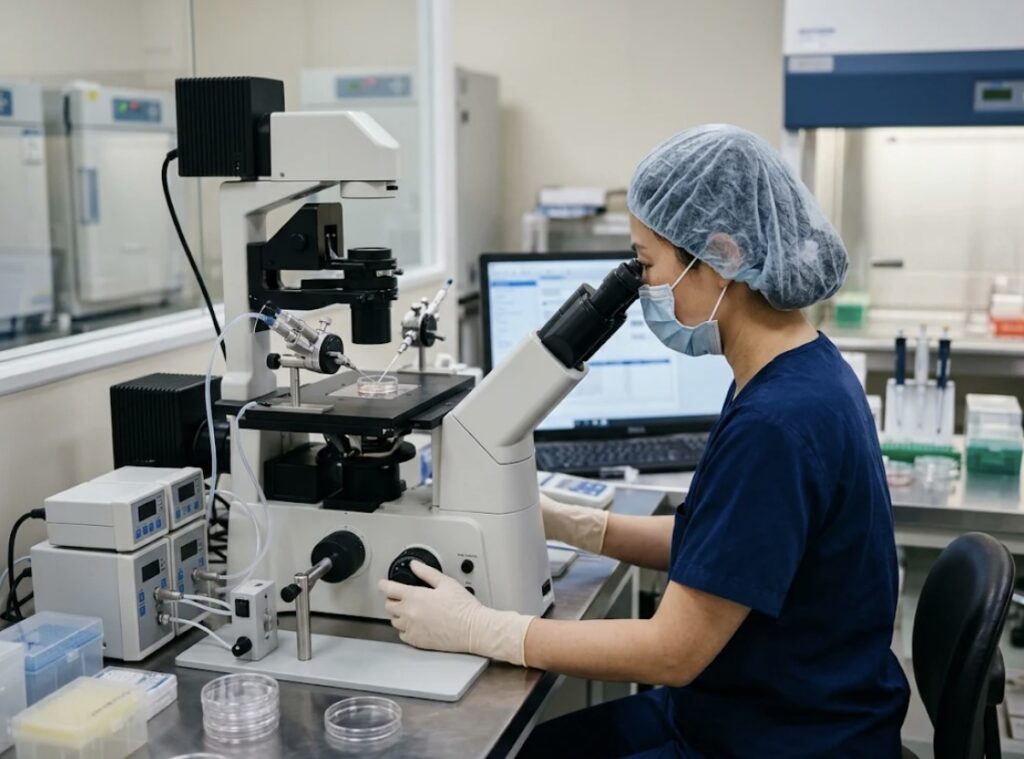
Without one clear cause to correct, treatment aims to raise your chance of pregnancy each cycle. ASRM calls this empiric treatment. Most plans move through the options below in order, adjusting as you go.
Expectant Management With Timed Intercourse
This means trying naturally for a set period, with guidance on timing and a review of your overall health. It may suit younger couples who haven’t been trying for long.
The monthly chance of pregnancy without treatment is modest; older studies put it at about 1.3% to 4.1% per cycle. That’s why this step usually has a clear end date. ASRM found that for couples with a good or intermediate outlook, several treatments worked no better than 6 months of expectant management.
Ovulation Induction With Intrauterine Insemination (IUI)
For many couples, the first active step is ovulation induction with oral medication, paired with intrauterine insemination. During IUI, washed sperm is placed directly in the uterus around ovulation.
ASRM recommends clomiphene citrate with IUI and considers letrozole with IUI a similar alternative. Letrozole isn’t FDA-approved for this purpose, so doctors prescribe it off-label. Most couples try 3 or 4 cycles before reassessing.
ASRM advises against IUI without medication, fertility medication with timed intercourse alone, and conventional dose injectable medications with IUI. Stimulating the ovaries can raise the chance of twins or more, so each cycle should be closely monitored.
In Vitro Fertilization (IVF)
In vitro fertilization retrieves eggs, fertilizes them in the lab, and transfers an embryo to the uterus. IVF bypasses the fallopian tubes and lets embryologists watch fertilization and early embryo growth, which can reveal factors other tests miss. Dr. Arjun Kadam leads our IVF lab.
ASRM describes IVF as the most effective option overall, though it’s more involved and more expensive. After 3 or 4 unsuccessful IUI cycles with oral medication, the guideline recommends IVF rather than switching to injectable medications with IUI.
IVF involves injectable medications, a brief egg retrieval procedure, and risks such as ovarian hyperstimulation syndrome (OHSS), which your care team monitors for. Success rates vary by age and individual factors, so ask any clinic for its current reported data.
ICSI and Other Lab Options
Intracytoplasmic sperm injection (ICSI) places a single sperm directly into each egg. For unexplained infertility, ASRM reports no difference in pregnancy or live birth rates between ICSI and conventional IVF. ICSI does lead to higher fertilization rates and fewer cycles with no fertilization. Preimplantation genetic testing (PGT) is another lab tool used in specific situations. Your specialist will tell you whether either one fits your case.
| Option | What it involves | Who it may suit | What to keep in mind |
|---|---|---|---|
| Expectant management | Timed intercourse for a set period | Younger couples who haven’t been trying long | Lowest cost; lower monthly chance |
| Oral medication with IUI | Clomiphene or letrozole plus insemination | Many couples as a first active step | Usually 3 to 4 cycles; monitoring for multiples |
| IVF (with or without ICSI) | Egg retrieval, lab fertilization, embryo transfer | Couples after unsuccessful IUI, or women 38 and older | Most effective overall; more involved and costly |
How Age and Time Trying Shape Your Plan
ASRM’s guideline gives helpful benchmarks for when to move from one step to the next:
- Under 38: IVF isn’t supported as a first step over 6 months of expectant management or a short course of ovulation induction with IUI.
- 38 and older: going straight to IVF may lead to a higher pregnancy rate and a shorter time to pregnancy.
- Up to 40: if clomiphene with IUI doesn’t work, moving to IVF led to a shorter time to pregnancy and a lower cost per pregnancy than adding an injectable IUI step.
Your ovarian reserve and how long you’ve been trying can shift these timelines too. ASRM also notes that many of the studies behind its advice were done before today’s IVF success rates, so your own results should guide the plan more than any single rule.
Weighing Cost, Time, and Emotional Readiness
Timed cycles and oral medication with IUI cost less. IVF costs more. We walk you through costs at each stage so there are no surprises. Qualifying patients may also be able to join clinical investigational studies that can offset much of the cost of certain procedures.
Time is a real factor. Monitoring visits fit around work, travel, and family, and appointment fatigue builds. So does the emotional weight of uncertainty, a partner who isn’t sure yet, or a past clinic experience that left you feeling rushed. Every one of those concerns belongs in the conversation with your care team.
IVFLA also offers acupuncture, massage therapy, and nutritional and integrative assessments. These can support your well-being during treatment. They aren’t a replacement for medical care.
Unexplained Infertility Care at IVFLA Fertility in Beverly Hills and Murrieta
When test results look normal, the details matter. Dr. Steven C. Presser has helped couples build their families since 1991. We start by reviewing your records, filling any testing gaps, and then choosing a plan based on your age, history, and goals.
Patients often notice the difference. As one couple put it, “We no longer feel like we’re just a number, getting rushed in and out without any of our concerns being addressed.”
Our Beverly Hills office on South La Cienega Boulevard serves patients from Los Angeles, West Hollywood, Santa Monica, Century City, and Culver City. Our Murrieta office on Elm Street serves Temecula, Menifee, Wildomar, Lake Elsinore, and the rest of Riverside County. If your plan calls for more advanced care, our fertility services include IVF, ICSI, PGT, egg donation, and reproductive surgery under one roof.
Preparing for Your First Consultation
Bring whatever you already have:
- Prior test results, including any semen analysis reports
- Notes on your cycles and any past treatment
- Insurance information
If you have a partner, try to come together. A few questions worth asking:
- Which tests haven’t been done yet?
- Which option fits our age and how long we’ve been trying?
- How many cycles should we try before we reassess?
- What will each step cost?
Frequently Asked Questions
1. Can couples with unexplained infertility still conceive naturally?
Some do. The monthly chance is lower than average and depends on age and how long you’ve been trying. A specialist can help you decide whether a short window of trying on your own or starting treatment makes more sense.
2. Is IUI or IVF better for unexplained infertility?
IVF is the more effective option per cycle, but it’s also more involved and more expensive. ASRM guidance often starts with oral medication and IUI for women under 38, while women 38 and older may benefit from moving to IVF sooner.
3. How many IUI cycles should we try before IVF?
ASRM suggests 3 or 4 cycles of oral medication with IUI. If pregnancy hasn’t happened by then, IVF is generally the recommended next step.
4. Does the male partner need testing?
Yes. A semen analysis is part of every standard fertility workup. Some sperm function issues only become visible during IVF, which is one more reason the lab can offer useful information.
5. Does an unexplained infertility diagnosis mean something was missed?
Not necessarily. It means routine tests didn’t find a clear cause. A specialist can review your past results and decide whether more testing would change your plan.
Moving Forward With a Clear Plan
Unexplained infertility is a frustrating label, but it’s also a starting point. Testing confirms the basics. Treatment moves in measured steps. Your age and how long you’ve been trying help set the pace, and the right team keeps the full picture in view.
If you’ve been told your infertility is unexplained, you don’t have to work out the next step on your own. Schedule a fertility consultation with IVFLA Fertility in Beverly Hills or Murrieta. We’ll review your history, answer your questions, and help you explore your options for parenthood.

Dr. Steven C. Presser is a Beverly Hills fertility specialist with over three decades of experience, trained at USC, Cedars-Sinai, and UCLA. He is widely recognized for his research and publications in reproductive health, nutrition, and fertility preservation, and is fluent in English, Spanish, and Hebrew.